

Virtual Reality and Productivity: Achieving Focus in Immersive Workspaces
Date Published

The New Frontier of Focus
In a world increasingly defined by digital noise, distractions are the enemy of productivity. Email notifications ping incessantly, social media alerts demand attention, and the home office—once a haven of focus—can feel like a minefield of interruptions. For many knowledge workers, maintaining flow, that elusive state where time seems to dissolve and work feels effortless, is more a matter of luck than strategy.
Enter Virtual Reality. Once the domain of gaming and entertainment, VR is now staking a claim in professional life. By immersing users in controlled, customizable environments, VR promises to reduce distractions, enhance concentration, and even foster creativity. Unlike traditional productivity tools, VR doesn’t just manage tasks—it reshapes the workspace itself.

Understanding Flow in Virtual Spaces
Psychologist Mihaly Csikszentmihalyi introduced the concept of flow as a state of deep engagement where skills and challenges are perfectly balanced. In traditional offices, achieving flow can be difficult; interruptions fragment focus and cognitive load spikes. Virtual Reality, however, can simulate environments tailored for focus.
In VR, visual and auditory distractions can be minimized. A VR workspace may replace the cluttered physical desk with a serene digital studio overlooking a forest, a quiet library, or a futuristic minimalistic office. Users report that even ambient details, like the subtle sound of a stream or soft background music, contribute to immersion without drawing attention away from the task.
Research supports these claims. A 2023 study published in Frontiers in Virtual Reality found that participants using VR work environments experienced a 25% increase in sustained attention and completed tasks with greater accuracy compared to standard desktop setups. These findings suggest that VR doesn’t just create the illusion of focus—it actively enhances cognitive performance.
VR Apps Designed for Productivity
Several VR applications have emerged with a clear emphasis on personal productivity. Each approaches immersion differently, but all share a commitment to minimizing distraction and maximizing presence.
Spatial: Originally designed for collaborative team work, Spatial creates customizable virtual offices where users can host meetings, share 3D objects, and brainstorm visually. Its strength lies in its social dimension, allowing teams to inhabit the same space without physical proximity while retaining a high degree of focus.
Vive Sync: Developed by HTC, Vive Sync transforms meetings and collaborative work into immersive sessions. Beyond meetings, it offers private workrooms where individuals can manipulate 3D models or interact with complex datasets, creating an unparalleled sense of presence.
Immersed: Targeted at remote workers, Immersed lets users simulate multiple monitors within a VR environment. Users can virtually “pin” windows, open documents, and create expansive workspaces without the physical limitations of a single monitor or cluttered desk. Testimonials suggest that the ability to customize workspace geometry directly correlates with improved concentration.
FocusVR: This app prioritizes mental clarity and workflow. By integrating meditation techniques, task segmentation, and biofeedback, FocusVR seeks to optimize productivity holistically. Users report that pairing VR immersion with mindfulness exercises reduces cognitive fatigue and enhances endurance for mentally intensive projects.
These apps exemplify the spectrum of VR productivity tools—from practical multi-monitor setups to sophisticated cognitive enhancement environments—demonstrating VR’s versatility as a professional aid.
User Experiences: Immersion in Action
While research provides quantitative insight, anecdotal evidence captures VR’s impact in real-world settings. Take Emma L., a freelance graphic designer based in Cape Town. Before adopting VR, Emma struggled with constant interruptions and the chaotic energy of her shared workspace. After integrating Immersed into her workflow, she describes an almost cinematic shift: “It’s like stepping into a studio I control completely. The distractions fade, and I can actually feel my brain sliding into focus. Tasks I dreaded now flow naturally.”
Similarly, Raj P., a software engineer, found that coding in a VR environment reduced mental fatigue during long sessions. By arranging multiple code windows around his virtual desk, he avoided the endless alt-tabbing of conventional monitors, which often fragmented his focus. Raj notes, “There’s a rhythm to VR work that desktop setups just can’t replicate. It’s immersive enough that you forget the outside world exists.”
These stories reflect broader trends in VR adoption. Early adopters consistently cite increased concentration, reduced mental strain, and enhanced engagement as key benefits. Many also highlight the psychological impact: VR can create a sense of “work presence,” fostering motivation and reducing procrastination.
Scientific Insights: Why VR Enhances Productivity
The benefits of VR for productivity are rooted in cognitive science. Immersion enhances attentional control by narrowing the field of perception. In VR, the brain prioritizes task-relevant stimuli while suppressing extraneous inputs. This aligns with findings from a 2022 study in Cognitive Technology Review, which found that VR environments significantly reduce the impact of multitasking distractions, allowing deeper focus and higher task completion rates.
Moreover, VR can leverage principles of embodied cognition. In physical terms, interacting with a virtual object engages similar neural circuits as interacting with a real one. This means designing in VR—moving, placing, and manipulating virtual elements—can feel intuitive and reinforce learning or creativity. Knowledge workers, designers, and data analysts can therefore benefit from VR’s capacity to simulate real-world interactions without physical constraints.
Challenges and Limitations
Despite its promise, VR productivity is not without hurdles. Prolonged use can cause eye strain, motion sickness, and fatigue for some users. The technology remains resource-intensive, requiring high-performance hardware and reliable internet connectivity. Additionally, social norms around VR in professional settings are still evolving; not all workplaces are ready to embrace employees working in headsets.
Security and privacy also present challenges. Virtual spaces are susceptible to data breaches if sensitive documents or communications are mishandled. As VR productivity solutions scale, developers must integrate robust encryption and access controls to protect user information.
The Future of VR Workspaces
Looking forward, VR’s role in personal productivity appears poised for expansion. Advances in eye-tracking, haptic feedback, and AI integration promise even more tailored and immersive experiences. Imagine a VR environment that dynamically adjusts lighting, sound, and workspace layout based on biometric feedback, optimizing focus in real time.
The implications extend beyond individual work. Distributed teams may one day collaborate in shared VR offices that mimic the spontaneity and energy of physical workplaces without requiring travel. VR could also integrate with emerging metaverse platforms, merging professional and creative ecosystems seamlessly.
Ultimately, VR does more than create virtual offices; it reshapes how we perceive work itself. By offering control over environment, distraction, and sensory input, it allows users to enter a state of flow with unprecedented ease. For professionals seeking focus, creativity, and efficiency, VR is less a novelty and more a transformative tool.
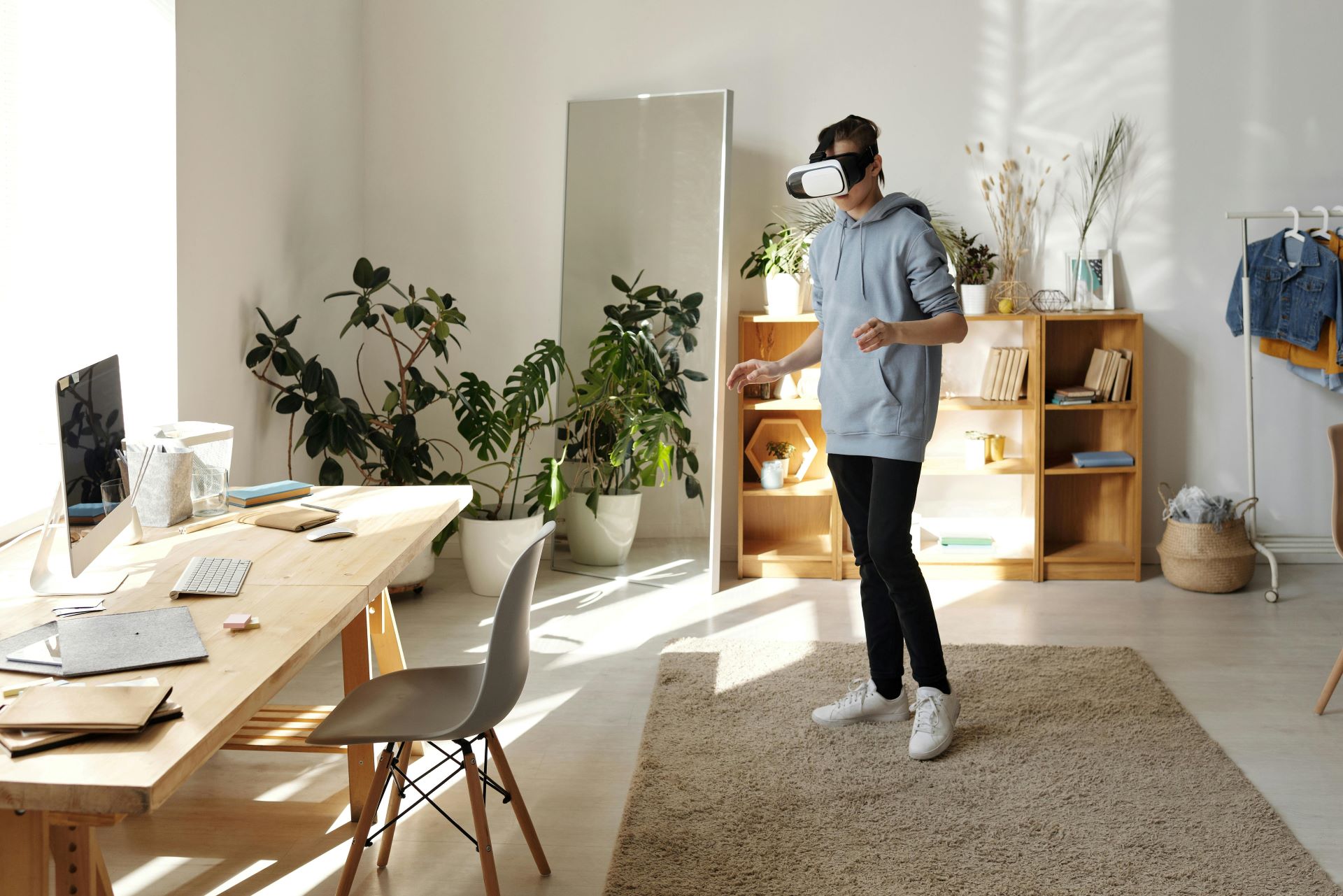
Immersive Focus as a Competitive Edge
The modern knowledge worker faces a paradox: the digital tools designed to increase productivity often undermine it. VR offers a compelling solution, harnessing immersion to filter distractions, enhance cognitive performance, and foster creative engagement. From multi-monitor simulations to fully interactive, meditative environments, VR empowers users to reclaim focus in a world awash with interruptions.
While challenges remain, early adopters and research alike indicate that virtual workspaces are more than futuristic experiments—they are viable tools for real productivity gains. As technology matures, VR may redefine the standard for personal productivity, offering a workspace that is limited only by imagination.
For those willing to embrace the headset, work is no longer confined to desk or screen. It becomes an immersive, purposeful experience—where focus is tangible, flow is natural, and productivity is limited only by the bounds of virtual space.